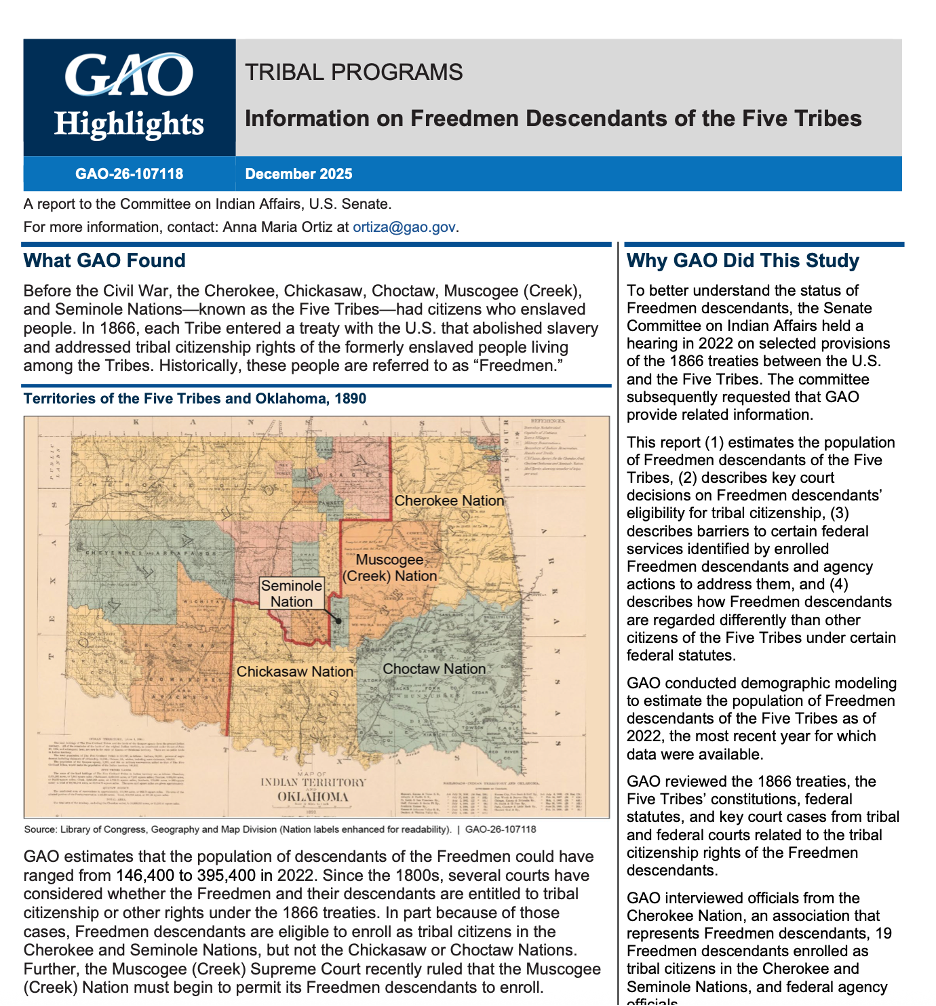
GAO Report on Freedmen Descendants of the Five Tribes
In January 2026, the U.S. Government Accountability Office (GAO) released a detailed report examining the historical background, population size, citizenship status, and ongoing challenges faced by Freedmen descendants of the Five Tribes — the Cherokee, Chickasaw, Choctaw, Muscogee (Creek), and Seminole Nations. Freedmen descendants are the living descendants of formerly enslaved people who were held by tribal citizens prior to the Civil War.
Historical Background
Before the Civil War, all five Tribes practiced slavery. After the war, each Tribe entered into Treaties of 1866 with the United States that abolished slavery and addressed the civil and political status of the formerly enslaved people and their descendants, historically referred to as Freedmen. These treaties remain central to modern discussions about tribal citizenship and rights.
Estimated Population of Freedmen Descendants
Using historical enrollment records and demographic modeling, the report estimates that as of 2022 there were between approximately 146,000 and 395,000 Freedmen descendants connected to the Five Tribes. This wide range reflects gaps and inconsistencies in historical records, including limitations of enrollment rolls.
Tribal Citizenship Status
The report finds that citizenship eligibility for Freedmen descendants varies by tribal nation, based on tribal constitutions, court rulings, and interpretations of treaty obligations:
Cherokee Nation is the only tribe that has fully recognized Freedmen descendants as eligible for tribal citizenship.
Seminole Nation Freedmen descendants have limited rights for tribal citizenship.
Chickasaw Nation and Choctaw Nation currently exclude Freedmen descendants from citizenship. This includes lineal descendants who were fathered by citizens of the respective nations.
Muscogee (Creek) Nation experienced a significant legal change in 2025, when its highest tribal court ruled that Freedmen descendants must be permitted to enroll as citizens; implementation is ongoing.
Note: The Freedmen descendants applying for citizenship are still facing barriers and delays- even after the recent court ruling.
Access to Federal and Tribal Services
The report highlights that even when Freedmen descendants are enrolled as tribal citizens, many experience barriers accessing services such as health care, education, housing, and other programs intended for tribal members. These barriers are often linked to inconsistent eligibility rules and administrative practices.
Differences in Treatment Under Federal Law
The report also notes that under certain federal statutes, Freedmen descendants may be treated differently from other tribal citizens, particularly in areas such as land ownership and aspects of legal jurisdiction. These differences contribute to ongoing inequities despite shared citizenship status.
Why This Report Matters
This report provides one of the most comprehensive federal examinations of the status of Freedmen descendants to date. It confirms that Freedmen descendants represent a large, living population with deep historical ties to the Five Tribes and that citizenship recognition and equal treatment remain unresolved issues in several tribal nations.
IMPORTANT NOTE:
If you are currently a Native American Freedmen Descendant, use the following link to connect with our descendant database:
https://www.ccfanow.org/identifying-freedmen.
READ THE FULL ARTICLE & HIGHLIGHTS - use the links below:
You may read a pdf version of the full report here: GAO Report of Freedmen in Indian Territory
The highlights of the report can be found here: GAO Highlights
Source: U.S. Government Accountability Office (GAO). Tribal Programs: Information on Freedmen Descendants of the Five Tribes (GAO-26-107118). Washington, D.C.: U.S. Government Accountability Office, published December 15, 2025, publicly released January 14, 2026. Available on the GAO website.
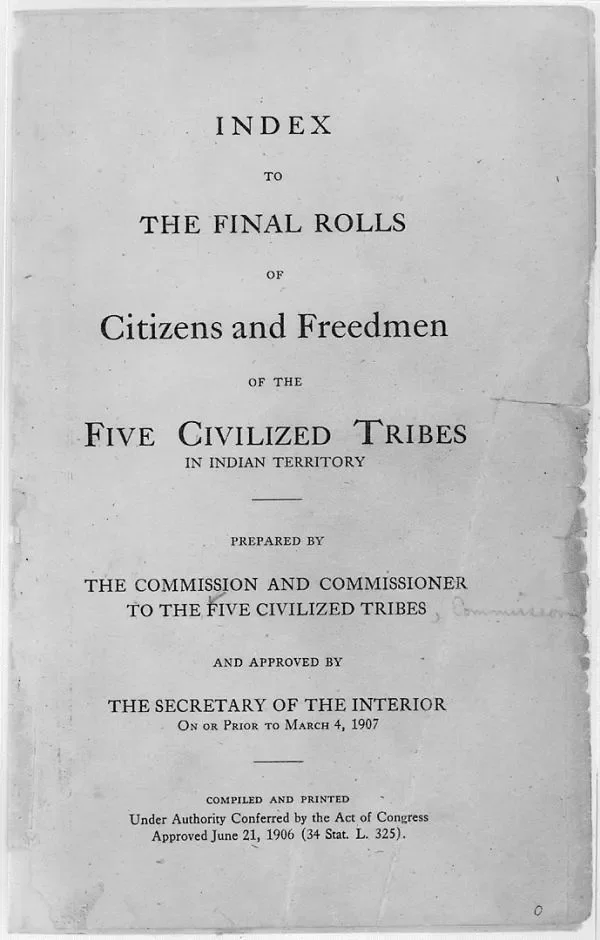
Have you identified your Choctaw or Chickasaw Freedmen ancestor on the final rolls? Let us know & Click here to get started.
If you are early in your research and haven’t located ancestors on “The Final Rolls”, use the searchable database provided by Oklahoma Historical Society site found here.